
Tool 9.1 - WBS (Work Breakdown Structure)
WHAT
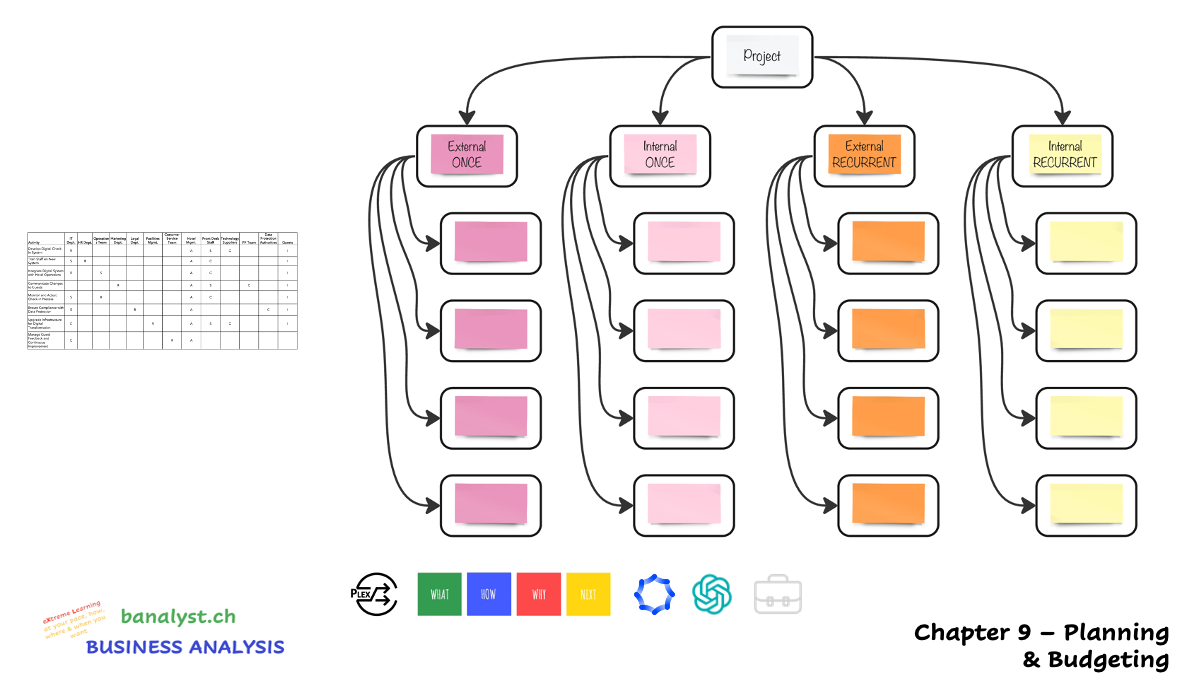
A Work Breakdown Structure (WBS) is a hierarchical decomposition of the total scope of work to be carried out by the project team to achieve the project objectives and create the required deliverables. It organizes and defines the total scope of the project, breaking it down into manageable sections where each level of the WBS provides further definition and detail. The WBS can be tailored to the needs of the project, with some focused on deliverables and others organized by project phases or a specific sequence of work. There are also WBSs that are structured with a focus on accounting and budgeting, categorizing the work by costs to aid in financial management and control. Essentially, the WBS is a foundational tool that provides the framework for detailed cost estimation, control, and project scheduling.
HOW
To create a Work Breakdown Structure (WBS) that incorporates external and internal jobs, whether they're one-time or recurrent tasks, and links to the prioritized requirements of the RASCI table, follow these steps:
-
Define Major Deliverables: Start by identifying the end deliverables of the project. These are typically the high-level objectives that the project aims to accomplish.
-
Break Down Deliverables: Decompose these major deliverables into smaller, more manageable pieces of work. For external and internal jobs, differentiate between one-time tasks (e.g., software installation) and recurrent tasks (e.g., monthly reporting).
-
Arbitrary Split: Recognize that the division of tasks into external/internal and one-time/recurrent is based on the project's unique needs and focus of analysis. Choose a split that best suits the way your project will be managed and monitored.
-
Assign Prioritized Requirements: Link each WBS element to the prioritized requirements from the RASCI table. Ensure each WBS item aligns with the project's scope and requirements, ensuring that all critical work is captured and prioritized.
-
Identify Stakeholders: For each WBS element, include a title and the stakeholders involved, referring to the RASCI table for who is Responsible, Accountable, Supporting, Consulted, and Informed. This ensures clear communication and responsibility allocation for each task.
Remember, the WBS is a living document that may evolve as the project progresses. It serves as a bridge between project objectives (what needs to be accomplished) and project planning (how it will be accomplished), effectively translating the scope into actionable tasks.
WHY
A Work Breakdown Structure (WBS) is done in Business Analysis to methodically break down projects into smaller, more manageable components or tasks. It helps in clearly defining the project scope by translating high-level objectives into specific deliverables and activities. The WBS is crucial for detailed planning; it enables analysts to estimate costs, resources, and timelines more accurately. It also facilitates risk identification and management by revealing dependencies and complexities early in the planning process. Furthermore, the WBS underpins effective communication among stakeholders by providing a common understanding of project work and progress, which is essential for coordination and collaboration.
NEXT
Here is a explanation of how a WBS can influence the chapters of the business analysis report:
-
Introduction (1.3 Methodology and approach) - Discuss the use of WBS as part of the project methodology to break down the scope and organize tasks.
-
Problem Statement (2.3 Impact and consequences) - The WBS can provide insight into how the problem affects project deliverables and processes, helping to clarify the impact and consequences of the problem.
-
Solution Options (6.1 Alternative solutions, 6.2 Evaluation criteria) - The WBS can help outline potential solutions and the criteria for evaluating them by detailing the tasks required to address each solution component.
-
Business Case Development (7.2 Financial projections and analysis) - Use the WBS to underpin the financial analysis, as it provides a detailed breakdown of tasks for cost estimation.
-
Implementation Plan (8.1 Project scope and timeline, 8.2 Resource and budget requirements, 8.3 Responsibilities) - Reflect on the detailed tasks and associated responsibilities from the WBS, establishing a comprehensive scope, timeline, and resource plan.
-
Requirements (9.1 Functional requirements) - Detail the functional requirements associated with each task in the WBS, ensuring all project needs are captured and prioritized.
-
Conclusion (10.2 Implications and next steps) - Summarize the implications of the WBS on project execution and outline the next steps informed by the task breakdown.
PROMPT
[instruction]
Based on the [case], the [pestel],[swot],[porters], [business context], [power-interest], [stakeholder-trend], [opportunities], [risks], [fishbone], [catwoe], [current story], [future story] the different [persona], the [force field analysis], [gaps], [popit], [value proposition canvas], [rasci] and [moscow] above, generate a sample Work-breakdown structure (WBS) with the project title between [ ] and below exactly the four sections [external investments], [internal investments], [external operational costs] and [internal operational costs]. List exactly 4 requirements for each of these sections. Develop them from the [must have] and the [should have] sections of the [moscow]. Estimate the estimated workload in hours for each of the stakeholders from the [rasci] implied and calculate with the following hourly tariffs : IT department CHF 220, HR department CHF 200, Operations Teams CHF 80, Marketing department CHF 130, Legal department CHF 280, Facilities management CHF 60, Customer service team CHF 110, Hotel Management CHF 300, Front Desk Staff CHF 90, Technology suppliers CHF 250, PR team CHF 180. Add also cash investments into material for each section.
CREDITS
Course : Business Analysis & Requirements Engineering
Institution : HES-SO Valais Wallis, 3960 Sierre
Teachers : Thomas Steiner & Catherine Tacchini
Credits
- FTO : X.XX ECTS
- FIG : X.XX ECTS
Objectives (with Babok 3 chapters)
- I understand the timing of BA work. 3.1.4.4
- I have basic knowledge of planning for requirements reuse. 3.4.4.4
- I understand reports on BA performance. 3.5.4.1
- I have basic knowledge of identifying BA performance measures. 3.5.4.2
- I have basic knowledge of assessing BA performance measures. 3.5.4.3
- I have basic knowledge of recommending BA performance improvements. 3.5.4.4
- I have basic knowledge of completing impact analysis activities. 5.4.4.2
- I have basic knowledge of guiding impact resolution activities. 5.4.4.3
- I understand identifying the expected benefits of a potential solution. 7.6.4.1
- I understand identifying the costs associated with a potential solution. 7.6.4.2
- I have applied Work Breakdown Structure WBS. case study
EXPLAINED
video explanations follow
PLEX
A PLEX, or Peer LEarning eXperience, is a self-contained, micro-learning unit created by students or teachers, designed to answer key questions like 'what?', 'how?', 'why?', and 'what's next?'. Each PLEX clearly outlines its learning objectives, associated micro-credits, and provides details about its original authors and their affiliations, making it a versatile resource for integration into various learning environments.
RASCI
The RASCI table, which incorporates prioritized requirements from the MoSCoW method along with identified stakeholders, can significantly aid in creating a Work Breakdown Structure (WBS) by offering a clear outline of what needs to be accomplished and who is responsible for each task. Here’s how it contributes to the development of a WBS:
-
Clarifying Scope and Deliverables: The prioritized requirements from the MoSCoW method inform the scope by defining the 'Must have' deliverables that form the backbone of the WBS.
-
Defining Tasks and Responsibilities: The RASCI table details who is responsible (R), accountable (A), supported by (S), consulted (C), and informed (I) for each requirement, providing a framework for assigning project roles within the WBS.
-
Ensuring Alignment with Objectives: By including stakeholders and their priorities, the WBS is more likely to align with business objectives and stakeholder expectations, leading to a focused and effective project plan.
-
Facilitating Communication: The inclusion of stakeholders in the WBS, as identified in the RASCI table, ensures that all parties are aware of their roles and the expectations of their involvement in the project.
-
Resource Allocation: Understanding the hierarchy of requirements and who is involved allows for better resource allocation when detailing the WBS, ensuring that the most critical tasks are adequately staffed and supported.
By integrating RASCI and MoSCoW into the WBS creation process, you can create a detailed and actionable project plan that clearly outlines each step necessary to meet project goals, who is responsible for executing each step, and the priority level of each task. This integrated approach streamlines the planning process and sets the foundation for successful project execution.
Tool 9.2 - Budgeting
WHAT
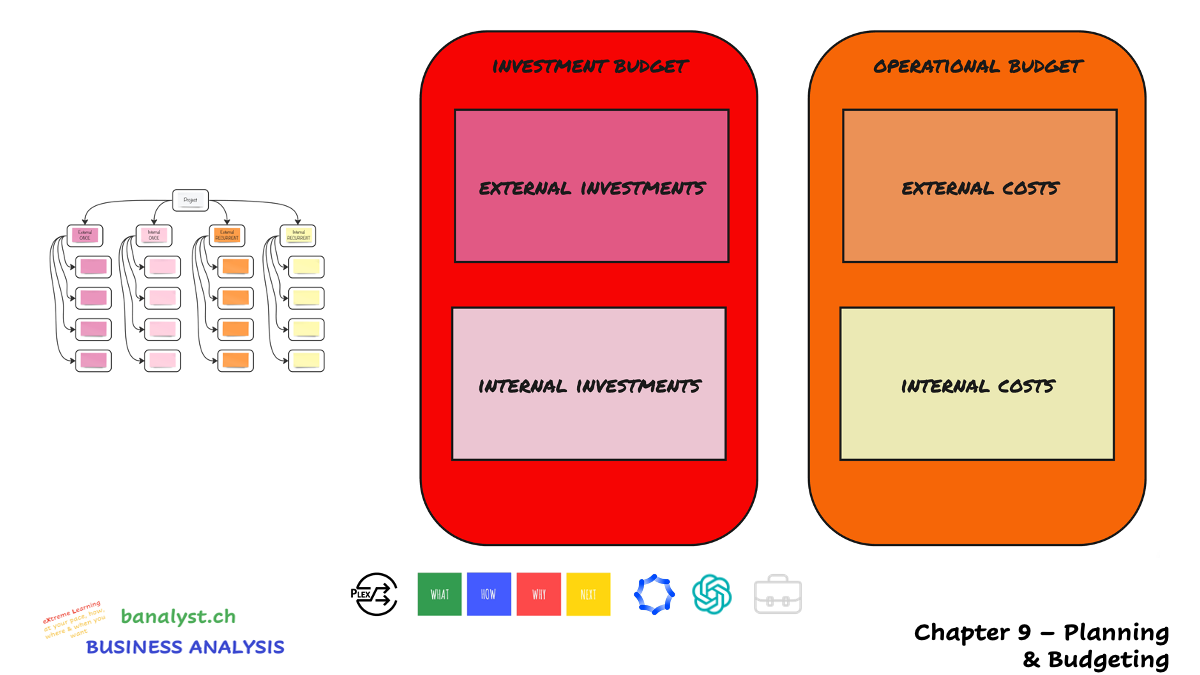
In business analysis, investment budgets and operational budgets serve distinct purposes. An investment budget, often referred to as a capital budget, is allocated for acquiring significant physical assets like property, plant, equipment, or making investments in long-term projects. These are typically large expenditures that are capitalized and then amortized or depreciated over their useful life. On the other hand, an operational budget (or operating budget) covers the day-to-day expenses required to run a business, such as salaries, utilities, and materials. This budget is used for the regular functioning of business operations within a fiscal year, focusing on managing revenue and expenses to ensure profitability.
HOW
Establishing investment and operational budgets involves detailed planning and a clear understanding of the project's financial needs, both in terms of capital and operational expenditures.
Investment Budgets:
- Identify Investments: Utilize the Work Breakdown Structure (WBS) to identify all required investments for the project, categorizing them as either internal (such as software development costs, machinery bought for manufacturing) or external investments (like acquiring a subsidiary, contracting with a supplier for specialized equipment).
- Capital and Work Elements: For each investment, determine the capital required (cash outlay) and the work hours involved. This includes the cost of acquisition for external investments and the internal resources needed for deployment or integration.
- Budgeting Method: Decide on a budgeting method. For example, using a linear depreciation method where the investment is depreciated evenly over its useful life, or a degressive method where depreciation is heavier in the initial years.
Operational Budgets:
- Estimate Operational Costs: Again, using the WBS, outline all operational activities and categorize their costs as internal (salaries, overheads, etc.) or external (outsourced services, third-party logistics, etc.).
- Capital and Work Considerations: Calculate both the direct costs and the work hours required for each operational activity, providing a comprehensive view of ongoing expenditures.
- Include Amortization: Include amortization costs for the investments. For instance, if an investment budget included the purchase of a machine with a 5% annual amortization rate, this cost must be factored into the operational budget as an annual expense.
Linking Investment and Operational Budgets:
- Ensure that the operational budget reflects the amortization of capital expenses from the investment budget. This connection highlights the ongoing cost impact of capital investments on the operational side of the business, ensuring that the financial planning is realistic and comprehensive.
- Regularly update both budgets as the project progresses and as actual expenses provide more data, recalibrating as necessary based on the performance and the financial health of the project or business.
By systematically linking the elements from the WBS with detailed financial planning, both investment and operational budgets can be established effectively, providing a solid financial foundation for project execution and management.
WHY
Investment and operational budgets are established in business analysis for several crucial reasons:
-
Resource Allocation: They help organizations allocate resources efficiently. Investment budgets focus on capital expenditures needed for long-term assets and projects, while operational budgets manage day-to-day operational expenses. This segregation ensures that both capital investments and daily operations are funded appropriately without overstretching financial resources.
-
Strategic Planning: These budgets are tools for strategic planning. Investment budgets allow companies to plan for future growth and expansion by allocating funds to new projects or capital improvements. Operational budgets ensure that the company's core operations are maintained smoothly, supporting the overall strategic goals of the organization.
-
Financial Control: Establishing these budgets provides a mechanism for financial control. They set financial boundaries for expenditures, helping to prevent overspending and ensuring that expenditures contribute to business objectives. By monitoring actual spending against these budgets, managers can control costs and adjust strategies as needed.
-
Performance Measurement: Both types of budgets serve as a baseline for measuring financial performance. Comparing actual expenditures and revenues against budgeted figures helps management understand how well the company is performing against its planned objectives, facilitating timely adjustments to improve efficiency and profitability.
-
Forecasting and Planning: Investment and operational budgets aid in financial forecasting and future planning. Understanding the costs and returns of capital investments and the ongoing costs of operations helps businesses predict future financial needs and cash flows, supporting more informed decision-making.
In essence, these budgets are foundational tools in business analysis, providing a structured approach to managing an organization's finances systematically and strategically. They help in balancing out expenditures between immediate operational needs and long-term strategic investments, crucial for sustained business growth and adaptation to changing market conditions.
NEXT
Here is a explanation of how investment and operational budgets can influence the chapters of the business analysis report:
-
Introduction (1.2 Purpose and scope of the report): Mention how investment and operational budgets are integral to the project's scope, underlining the financial boundaries and goals of the project.
-
Problem Statement (2.3 Impact and consequences): Discuss the financial implications of the problem being analyzed, which can be understood better through the lens of required investments and operational costs to mitigate these issues.
-
Including investment and operational budgets in these sections ensures that financial considerations are thoroughly integrated into the strategic planning and execution stages of the project, providing clarity and direction for financial management and decision-making.
-
Solution Options (6.1 Alternative solutions, 6.3 Recommendation and justification): Detail how different solutions compare in terms of investment and operational costs, providing a justification for the recommended solution based on cost-effectiveness and budget alignment.
-
Business Case Development (7.1 Cost-benefit analysis, 7.2 Financial projections and analysis): Include detailed investment and operational budgets here to illustrate the financial viability and forecasted returns of the project, supporting the business case with quantitative analysis.
-
Implementation Plan (8.2 Resource and budget requirements): Clearly outline how the investment and operational budgets will be allocated throughout the project timeline, specifying funding sources and scheduling for expenditure.
-
Conclusion (10.2 Implications and next steps): Summarize how adherence to the investment and operational budgets will affect the project’s future phases and ongoing financial planning, emphasizing the importance of budget management in achieving project goals.
PROMPT
[instruction]
Based on the [case], the [pestel],[swot],[porters], [business context], [power-interest], [stakeholder-trend], [opportunities], [risks], [fishbone], [catwoe], [current story], [future story] the different [persona], the [force field analysis], [gaps], [popit], [value proposition canvas], [rasci], [moscow] and [wbs] above, generate an [investment budget] and an [operational budget]. The operational budget must contain at the end a line with the amortisation of 5% of the total investment. Detail work (hours) and material (cash) for each budget entry and sum them up.
CREDITS
Course : Business Analysis & Requirements Engineering
Institution : HES-SO Valais Wallis, 3960 Sierre
Teachers : Thomas Steiner & Catherine Tacchini
Credits
- FTO : X.XX ECTS
- FIG : X.XX ECTS
Objectives (with Babok 3 chapters)
- I understand the timing of BA work. 3.1.4.4
- I have basic knowledge of planning for requirements reuse. 3.4.4.4
- I understand reports on BA performance. 3.5.4.1
- I have basic knowledge of identifying BA performance measures. 3.5.4.2
- I have basic knowledge of assessing BA performance measures. 3.5.4.3
- I have basic knowledge of recommending BA performance improvements. 3.5.4.4
- I have basic knowledge of completing impact analysis activities. 5.4.4.2
- I have basic knowledge of guiding impact resolution activities. 5.4.4.3
- I understand identifying the expected benefits of a potential solution. 7.6.4.1
- I understand identifying the costs associated with a potential solution. 7.6.4.2
- I have established investment and operational budgets. case study
EXPLAINED
video explanations follow
PLEX
A PLEX, or Peer LEarning eXperience, is a self-contained, micro-learning unit created by students or teachers, designed to answer key questions like 'what?', 'how?', 'why?', and 'what's next?'. Each PLEX clearly outlines its learning objectives, associated micro-credits, and provides details about its original authors and their affiliations, making it a versatile resource for integration into various learning environments.
WBS
The Work Breakdown Structure (WBS) is a crucial tool in project management that helps in organizing and detailing the components and tasks necessary to complete a project. Here's how the WBS can assist in establishing investment and operational budgets:
-
Detailed Breakdown of Tasks and Deliverables: The WBS dissects the project into smaller, more manageable parts, each representing a specific task or deliverable. This granular breakdown makes it easier to understand what resources (human, material, technological) are needed for each part, facilitating a more accurate estimation of costs.
-
Resource Allocation and Cost Estimation: By detailing each task, the WBS allows project managers to assign resources to specific components. This helps in estimating the costs associated with labor (i.e., hours worked by different departments or contractors) and materials (i.e., physical or digital assets required). Each element of the WBS is mapped to the necessary resources, and costs are assigned based on the resource requirements.
-
Identification of Investment and Operational Costs: The WBS distinguishes between different types of expenses:
- Investment Costs: These are typically one-time expenses required to initiate the project. In the case of a digital check-in system, investment costs include purchasing hardware like kiosks, developing software, or upgrading IT infrastructure. The WBS helps identify all such costs by outlining all tasks that involve setup and implementation.
- Operational Costs: These include recurring expenses necessary to maintain the project outcomes. Through the WBS, tasks that will recur or require ongoing support, such as maintenance, training, and system updates, can be identified, helping in planning the operational budget.
-
Timeline Synchronization with Budget Planning: WBS also aligns project tasks with a timeline, aiding in cash flow forecasting. Understanding when expenses will likely occur during the project lifecycle is crucial for budgeting. Investment costs are generally upfront, whereas operational costs are spread throughout the project's operational phase.
-
Budget Revisions and Tracking: As the project progresses, the WBS can be used to track actual vs. budgeted costs. This tracking helps in identifying areas where the project may be over or under budget, allowing for timely adjustments. The WBS structure makes it clear which part of the project is deviating from the budget, simplifying the process of pinpointing issues and addressing them efficiently.
In summary, the WBS is an essential tool for creating accurate and comprehensive investment and operational budgets. It provides a structured approach to cost allocation that enhances financial planning, management, and control in project settings, ensuring that financial resources are used efficiently to achieve project goals.
Tool 9.3 - CBA (Cost-Benefit Analysis)
WHAT
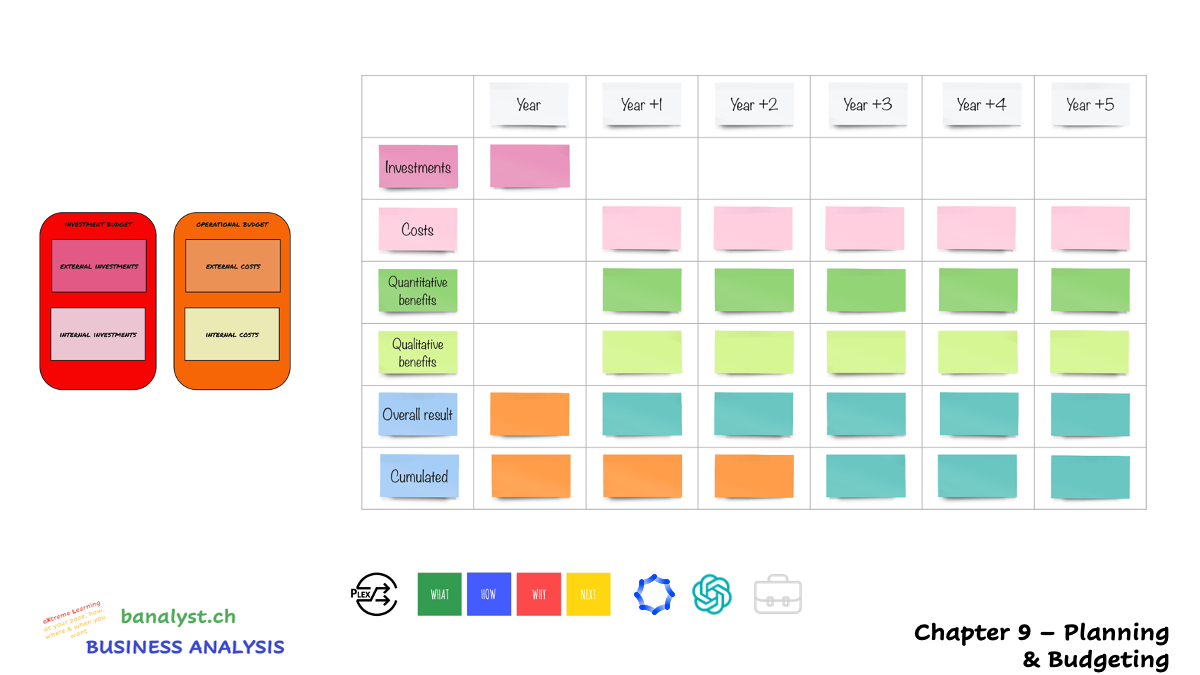
A cost-benefit analysis (CBA) is a systematic approach used in business analysis to evaluate the financial viability of a project or decision by comparing its costs to the benefits it will generate. This analysis involves enumerating and quantifying all costs associated with a project—such as initial investment and ongoing operational expenses—and all benefits, which could include direct and indirect revenue, cost savings, and intangible gains. The goal is to determine if the benefits outweigh the costs and by how much, helping decision-makers choose the most beneficial strategies with a clear understanding of financial returns. A critical aspect of CBA is assigning a monetary value to all factors, which can sometimes include subjective or intangible aspects such as customer satisfaction and environmental impact. Ultimately, the result of a cost-benefit analysis can be expressed as a net value or a benefit-cost ratio, providing a clear, quantified basis for comparing different projects or decisions.
HOW
To establish a Cost-Benefit Analysis (CBA) from investment and operational budgets, follow these steps:
-
Identify Costs: Start by detailing all costs involved in the project. This includes both initial and ongoing expenses. From the investment budget, capture all capital expenditures such as equipment purchases, facility upgrades, and any one-time costs associated with the project setup. From the operational budget, include all recurring costs like salaries, maintenance, utilities, and other day-to-day expenses that will continue throughout the life of the project.
-
Quantify Benefits: Next, identify and quantify the expected benefits. These can include direct financial gains such as increased revenues or indirect benefits such as improved customer satisfaction, time savings, and efficiency improvements which can also be translated into monetary values. Estimate the financial value of each benefit, aiming to be as precise as possible by using historical data, market analysis, or projected forecasts.
-
Calculate Net Benefits: Subtract the total costs from the total benefits to calculate the net benefit. This figure can be presented as a total net value or broken down into an annual or monthly value depending on the project's duration and reporting needs.
-
Conduct Sensitivity Analysis: Since CBA often involves estimates and projections, it's important to perform sensitivity analysis. This involves adjusting the cost and benefit figures to see how changes affect the overall net benefit. This helps to understand the risk and potential variability in the outcomes.
-
Present Results: Summarize the findings in a clear format, typically in a report or presentation. Include a detailed breakdown of costs and benefits, the net benefit calculation, and insights from the sensitivity analysis. This presentation should clearly articulate the financial viability of the project and support decision-making processes.
By aligning the CBA with detailed investment and operational budgets, you ensure that all financial aspects of the project are considered, providing a robust foundation for evaluating its economic worth. This methodical approach helps stakeholders understand the financial implications of project decisions comprehensively.
WHY
A Cost-Benefit Analysis (CBA) is conducted in business analysis for several pivotal reasons:
-
Informed Decision-Making: CBA provides a systematic evaluation of the economic feasibility of a project or decision by quantifying its costs and benefits. This analysis supports decision-makers in assessing whether the potential benefits of a project justify the expenses, guiding them to make informed, financially prudent decisions.
-
Resource Allocation: By highlighting the expected returns on investment, CBA helps organizations allocate their resources more efficiently. It identifies projects with the highest potential for positive economic impact, ensuring that capital and resources are invested in the most beneficial ventures.
-
Risk Assessment: CBA includes an assessment of various potential outcomes and their impacts, allowing businesses to understand and prepare for the risks associated with different choices. This can include financial risks, operational risks, and market-based risks, providing a comprehensive view of potential challenges.
-
Performance Measurement: By comparing the anticipated benefits against the actual outcomes, CBA can also serve as a tool for performance measurement post-implementation. This helps in validating the initial projections and refining future analysis and decision-making processes.
-
Transparency and Accountability: Conducting a CBA promotes transparency and accountability in how decisions are made, which can be critical in securing stakeholder support or funding, especially in public sector or large-scale corporate projects.
Overall, CBA is a fundamental tool in business analysis for its role in supporting strategic and operational decision-making by quantifying and comparing the economic value of different options.
NEXT
Here is a explanation of how a CBA can influence the chapters of the business analysis report:
-
Introduction (1.3 Methodology and approach): Outline that CBA is part of the analytical methodology used to evaluate the feasibility of the project options presented in the report.
-
Problem Statement (2.3 Impact and consequences): Discuss the financial impact of the problem and how the findings from the CBA help quantify these consequences and justify the need for intervention.
-
Solution Options (6.2 Evaluation criteria, 6.3 Recommendation and justification): Use CBA to evaluate the various solutions proposed. Include it as a key criterion for selecting the recommended option, providing financial justification for why one solution is preferable over others.
-
Business Case Development (7.1 Cost-benefit analysis): This is the primary section for the detailed presentation of the CBA. Here, all costs (initial and ongoing) and benefits (tangible and intangible) should be quantified and compared to demonstrate the net value or return on investment of the project.
-
Implementation Plan (8.2 Resource and budget requirements): Link the results of the CBA to the budgeting and resource allocation plans, showing how the expected benefits justify the investments and operational costs outlined.
-
Conclusion (10.1 Summary of findings and recommendations): Summarize how the CBA supports the overall findings and recommendations of the report, emphasizing the financial rationale behind the final decisions and proposed next steps.
PROMPT
[instruction]
Based on the [case], the [pestel],[swot],[porters], [business context], [power-interest], [stakeholder-trend], [opportunities], [risks], [fishbone], [catwoe], [current story], [future story] the different [persona], the [force field analysis], [gaps], [popit], [value proposition canvas], [rasci], [moscow], [wbs], [investment budget] and [operational budget] above, generate a [cost benefit analysis]. Assume that the investment is done this year and project operational costs over 5 years starting from next year. The direct quantative earnings consist of CHF 100'000 per operational year from a rise of the room prices to cover a part of the new system. Imagine three indirect earnings (for example additional bookings from the attractiveness of having online booking etc.) for a total of CHF 50'000 per operational year. Put the years (starting from now plus 5 operational years) in the columns of the table. Start with the investment costs for the first year in the rows. Plan them all for this year. There are no earnings for this year. Continue with the operational costs in the following rows. Finally add the quantitative earnings and the qualitative earnings in the following rows. Below, calculate the overall project result for each year. And calculate the cumulative project result for each year.
CREDITS
Course : Business Analysis & Requirements Engineering
Institution : HES-SO Valais Wallis, 3960 Sierre
Teachers : Thomas Steiner & Catherine Tacchini
Credits
- FTO : X.XX ECTS
- FIG : X.XX ECTS
Objectives (with Babok 3 chapters)
- I understand the timing of BA work. 3.1.4.4
- I have basic knowledge of planning for requirements reuse. 3.4.4.4
- I understand reports on BA performance. 3.5.4.1
- I have basic knowledge of identifying BA performance measures. 3.5.4.2
- I have basic knowledge of assessing BA performance measures. 3.5.4.3
- I have basic knowledge of recommending BA performance improvements. 3.5.4.4
- I have basic knowledge of completing impact analysis activities. 5.4.4.2
- I have basic knowledge of guiding impact resolution activities. 5.4.4.3
- I understand identifying the expected benefits of a potential solution. 7.6.4.1
- I understand identifying the costs associated with a potential solution. 7.6.4.2
- I have done a Cost Benefit Analysis. case study
EXPLAINED
video explanations follow
PLEX
A PLEX, or Peer LEarning eXperience, is a self-contained, micro-learning unit created by students or teachers, designed to answer key questions like 'what?', 'how?', 'why?', and 'what's next?'. Each PLEX clearly outlines its learning objectives, associated micro-credits, and provides details about its original authors and their affiliations, making it a versatile resource for integration into various learning environments.
Operational and Investment Budgets
Investment and operational budgets play a crucial role in establishing a Cost-Benefit Analysis (CBA) by providing detailed insights into the financial aspects of a project. Here’s how they contribute:
-
Foundational Inputs for CBA: Investment budgets detail the initial capital outlays required for project assets, technology, infrastructure, or other significant purchases. These are essential for calculating the upfront costs in the CBA. Operational budgets, on the other hand, provide information on the recurring costs associated with running the project, including maintenance, salaries, utilities, and other day-to-day expenses.
-
Quantifying Benefits: Both types of budgets help in estimating potential financial benefits. For example, investment in new technology might lead to increased operational efficiency, resulting in cost savings that are captured in the operational budget. These savings become tangible benefits in the CBA.
-
Amortization and Depreciation: Investment budgets help calculate depreciation or amortization costs, which are important for understanding how the capital expenses impact financial statements over time. These figures are crucial for the CBA as they reflect the spreading out of the cost of an asset over its useful life, affecting the net benefits calculation.
-
Risk Assessment: Detailed budgets aid in risk assessment by providing a clearer picture of where financial strains may occur, such as where costs may overrun or savings are overestimated. This insight is critical for a CBA, as it helps in modeling different scenarios and understanding the potential financial impact under varying conditions.
-
Strategic Alignment and Decision Making: By aligning investment and operational budgets with the CBA, organizations can ensure that their financial planning supports their strategic goals. The CBA can reveal whether the potential returns justify the planned expenditures, aiding decision-makers in pursuing, modifying, or possibly abandoning projects based on their financial viability.
In summary, investment and operational budgets provide the numerical data necessary to perform a robust CBA, ensuring that all costs and benefits are accounted for and assessed in the decision-making process. This thorough financial evaluation helps in strategically steering projects toward successful outcomes.