Tool 6.1 - Customer Journey
WHAT
A general customer journey outlines the complete experience a customer goes through when interacting with a brand or product, from initial awareness to post-purchase feelings and actions. It encompasses several phases: awareness, consideration, decision, purchase, and post-purchase, including loyalty and advocacy. This journey helps businesses understand and improve every interaction point to enhance customer satisfaction, loyalty, and advocacy, ensuring that every step adds value and fosters a positive, lasting relationship with the brand.
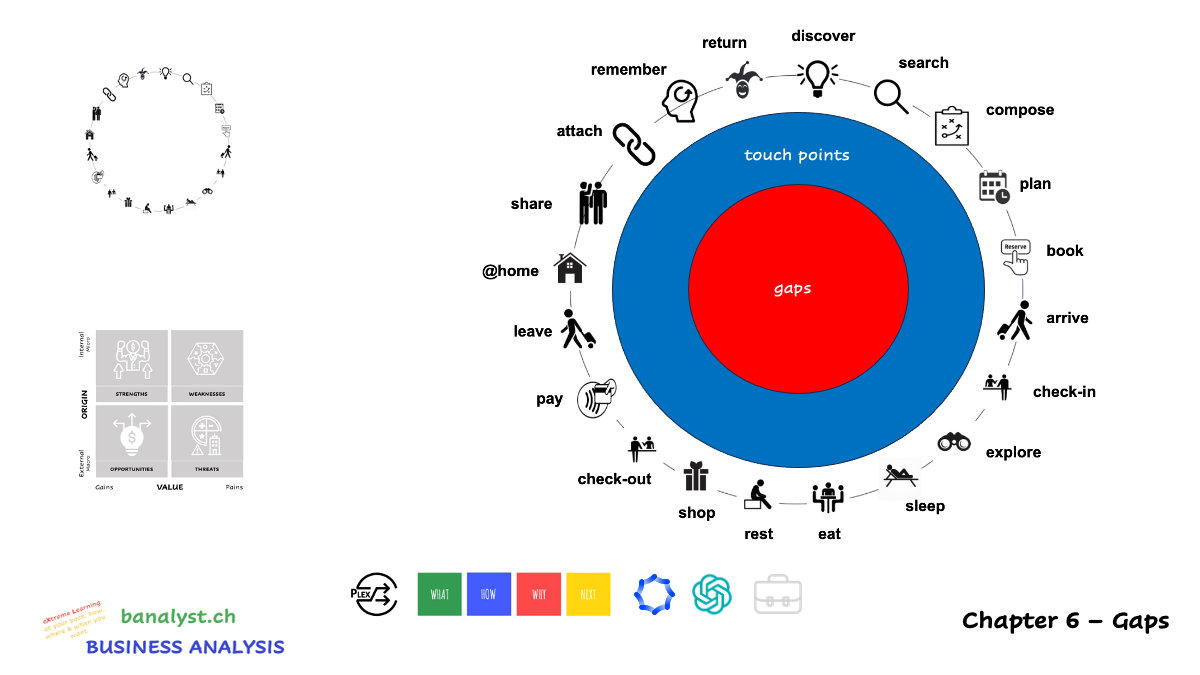
A customer journey in tourism describes the complete cycle a tourist goes through, from becoming aware of a destination to considering it, deciding to visit, experiencing the destination, and finally, reflecting on the experience. Ideally, this journey is circular, with a satisfying experience encouraging tourists to return to the destination or recommend it to others. It encompasses all interactions tourists have with the destination, services, and products, highlighting the importance of each touchpoint in creating a positive, memorable experience that drives repeat visits and positive word-of-mouth.
HOW
To analyze a customer journey, identify key touchpoints where customers interact with the brand, product, or service. Map these interactions from initial awareness through to post-purchase behavior. Collect data at each touchpoint to understand customer experiences, emotions, and decision-making processes. Use this analysis to identify areas of friction or opportunities for improvement, aiming to enhance the overall customer experience, increase satisfaction, and drive loyalty. This process requires continuous monitoring and adaptation to meet changing customer needs and expectations.
WHY
Analyzing a customer journey allows businesses to understand how customers interact with their brand from initial awareness to post-purchase. This insight helps identify pain points, areas for improvement, and opportunities to enhance satisfaction and loyalty. By understanding the customer's experience, businesses can tailor their offerings and communications to better meet customer needs, ultimately driving higher engagement, retention, and advocacy.
NEXT
Here is a explanation of how a Force Field Analysis can influence the chapters of the business analysis report:
The results of a Customer Journey analysis can be integrated into various sections of a Business Analysis report:
- Introduction (1.3 Methodology and approach) - Explaining how the customer journey analysis was conducted as part of the research approach.
- Problem Statement (2.3 Impact and consequences) - Detailing how issues in the customer journey impact the business or customer experience.
- Customer Analysis (4.1-4.3) - Deep insights into customer segments, needs, pain points, and behaviors derived from the journey analysis.
- SWOT Analysis (5.1-5.4) - Influences from the customer journey can highlight strengths, weaknesses, opportunities, and threats.
- Solution Options (6.3 Recommendation and justification) - Proposing solutions based on insights from the customer journey analysis.
- Business Case Development (7.2 Financial projections and analysis) - Projecting how improvements in the customer journey could affect the financial outlook.
- Implementation Plan (8.1-8.3) - Planning changes or projects to enhance the customer journey.
- Requirements (9.1-9.3) - Defining what needs to be addressed or changed based on the customer journey findings.
- Conclusion (10.1-10.3) - Summarizing how insights from the customer journey analysis inform the report’s findings and recommendations.
PROMPT
[instruction]
Based on the [case], the [pestel],[swot],[porters], [business context], [power-interest], [stakeholder-trend], [opportunities], [risks], [fishbone], [catwoe], [current story], [future story] the different [persona] and the [force field analysis] above, identify the major gaps between the [current story] and the [future story] in the following phases of the [tourist experience] : discover, search, compose, plan, book, arrive, check-in, explore, sleep, eat, rest, shop, check-out, pay, leave, home, share, attach, remember, return. List the concerned phases between [ ] under the [gaps] and explain with a short sentence whats missing. Only mention the phases where there is concretely something missing. Do not explain for each phase but really only for the mainly concerned ones.
CREDITS
Course : Business Analysis & Requirements Engineering
Institution : HES-SO Valais Wallis, 3960 Sierre
Teachers : Thomas Steiner & Catherine Tacchini
Credits
- FTO : X.XX ECTS
- FIG : X.XX ECTS
Objectives (with Babok 3 chapters)
- I have basic knowledge of maintaining requirement and design information. 5.2.4.1
- I have basic knowledge of managing attributes. 5.2.4.2
- I have basic knowledge of managing requirements for long term reuse. 5.2.4.3
- I understand allocating requirements to solution components and releases. 7.5.4.3
- I have basic knowledge of determining the value of a solution to key stakeholders. 7.6.4.3
- I have basic knowledge of assessing design options and recommending the appropriate solution. 7.6.4.4
- I have applied a customer journey. case study
EXPLAINED
video explanations follow
PLEX
A PLEX, or Peer LEarning eXperience, is a self-contained, micro-learning unit created by students or teachers, designed to answer key questions like 'what?', 'how?', 'why?', and 'what's next?'. Each PLEX clearly outlines its learning objectives, associated micro-credits, and provides details about its original authors and their affiliations, making it a versatile resource for integration into various learning environments.
TOUCH POINTS
Touchpoints in customer journey analysis represent the various stages where customers interact with the brand, product, or service. These interactions can significantly influence the customer's perception, experience, and decision-making process. By analyzing touchpoints, businesses can identify opportunities for improvement, enhance customer satisfaction, and tailor the journey to meet customer needs more effectively, ultimately leading to increased loyalty and advocacy.
GAPS
To derive gaps at touchpoints between current and future customer experiences, map out the customer journey, identifying all existing touchpoints. Assess each touchpoint for effectiveness, customer satisfaction, and alignment with business goals. Then, envision the ideal future customer experience, identifying new or modified touchpoints that enhance the journey. Compare the current and future state to identify gaps in service, experience, or expectations. Prioritize these gaps for improvement to bridge the current experience towards the envisioned future state, focusing on areas with the most significant impact on customer satisfaction and business objectives.
TEX - The Tourist Experience Wheel
The Tourist Experiece Wheel seen at the beginning of our course show the typical phases of a customer journey in tourism.
SWOT
A SWOT analysis can help in analyzing customer experience by identifying strengths (what's working well in current customer interactions), weaknesses (areas of the customer experience that need improvement), opportunities (potential ways to enhance the customer journey), and threats (external factors that could negatively impact the customer experience). By applying SWOT to the analysis of touchpoints, businesses can effectively pinpoint gaps between the current state and the desired future state of the customer journey, facilitating targeted improvements to optimize overall customer satisfaction and engagement.
Tool 6.2 - POPIT
WHAT
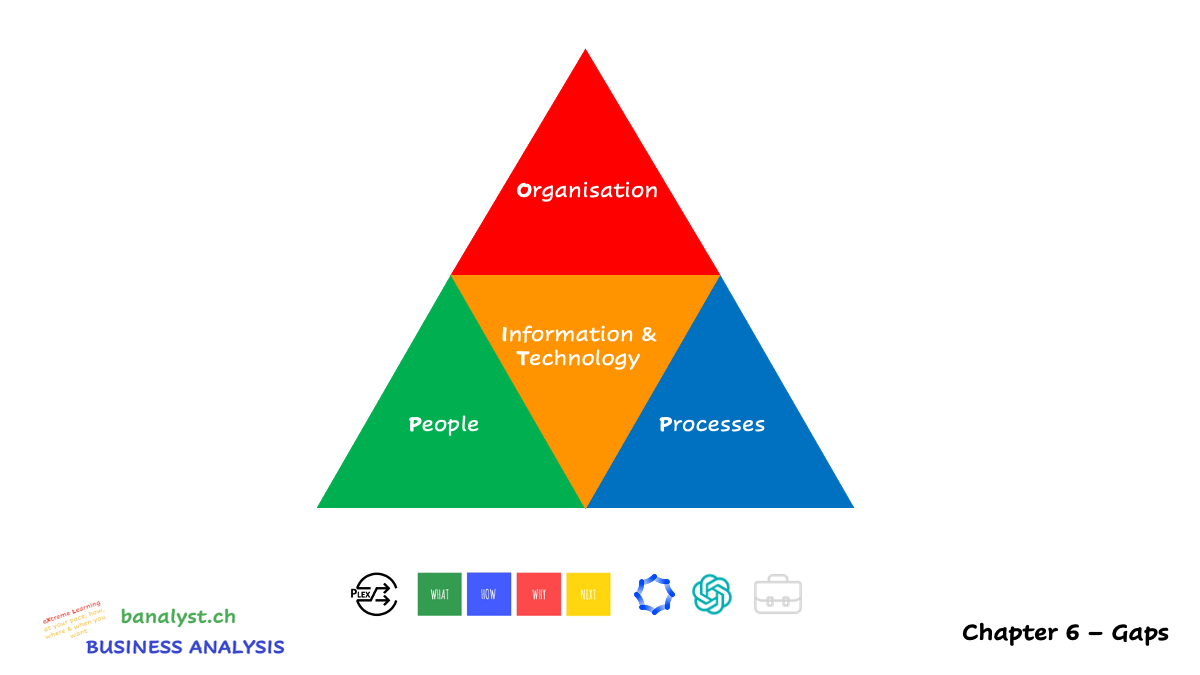
A POPIT analysis focuses on People, Organization, Processes, and Information Technology to identify the impact of changes within a business context. It helps in understanding the gaps between an existing situation and a proposed new one by examining how each element is affected by change. This holistic approach ensures a comprehensive view of the transition, highlighting potential challenges and areas needing attention to ensure a smooth implementation and alignment with business goals. It's particularly useful for managing change effectively, ensuring all aspects of the organization are considered.
HOW
To conduct a POPIT analysis focusing on gaps, systematically examine each element—People, Organization, Processes, and Information Technology. Start by identifying the current state of these areas and then define the desired future state. Analyze the differences to identify gaps in skills, organizational structure, workflows, and technology usage. Determine the impact of these gaps on achieving the new objectives and develop strategies to bridge them. This approach ensures a comprehensive understanding of the changes needed to transition from the existing to the new situation effectively.
WHY
A POPIT analysis is conducted in Business Analysis to comprehensively understand the multifaceted impacts of changes across People, Organization, Processes, and Information Technology. By identifying gaps in these areas between the current and desired future states, it helps in pinpointing specific requirements for change management. This detailed insight allows for the development of concrete and actionable requirements, ensuring that solutions are holistic and address all aspects necessary for successful implementation and transformation within the organization.
NEXT
Here is a explanation of how a Force Field Analysis can influence the chapters of the business analysis report:
- Introduction (1.3 Methodology and approach) - Describing how POPIT analysis was used in the research approach.
- Problem Statement (2.2 Root cause analysis and 2.3 Impact and consequences) - Highlighting gaps and their impacts identified through POPIT.
- Solution Options (6.1 Alternative solutions, 6.2 Evaluation criteria, and 6.3 Recommendation and justification) - Informing solution development with insights from POPIT analysis.
- Business Case Development (7.1 Cost-benefit analysis and 7.3 Risk assessment and management) - Using POPIT findings to build the business case and manage risks.
- Implementation Plan (8.1 Project scope and timeline, 8.2 Resource and budget requirements, and 8.3 Responsibilities) - Guiding implementation strategies based on POPIT insights.
- Requirements (9.1 Functional requirements) - Defining requirements that address the identified gaps.
- Conclusion (10.2 Implications and next steps) - Summarizing how POPIT analysis impacts the project’s direction and next steps.
PROMPT
[instruction]
Based on the [case], the [pestel],[swot],[porters], [business context], [power-interest], [stakeholder-trend], [opportunities], [risks], [fishbone], [catwoe], [current story], [future story] the different [persona], the [force field analysis] and the [gaps] above, do a POPIT analysis. Write the missing elements for a fully functioning [future story] compared to the [actual story] as bullet points under element of the [popit]. Put the elements between [ ]
CREDITS
Course : Business Analysis & Requirements Engineering
Institution : HES-SO Valais Wallis, 3960 Sierre
Teachers : Thomas Steiner & Catherine Tacchini
Credits
- FTO : X.XX ECTS
- FIG : X.XX ECTS
Objectives (with Babok 3 chapters)
- I have basic knowledge of maintaining requirement and design information. 5.2.4.1
- I have basic knowledge of managing attributes. 5.2.4.2
- I have basic knowledge of managing requirements for long term reuse. 5.2.4.3
- I understand allocating requirements to solution components and releases. 7.5.4.3
- I have basic knowledge of determining the value of a solution to key stakeholders. 7.6.4.3
- I have basic knowledge of assessing design options and recommending the appropriate solution. 7.6.4.4
- I have applied a POPIT analysis. case study
EXPLAINED
video explanations follow
PLEX
A PLEX, or Peer LEarning eXperience, is a self-contained, micro-learning unit created by students or teachers, designed to answer key questions like 'what?', 'how?', 'why?', and 'what's next?'. Each PLEX clearly outlines its learning objectives, associated micro-credits, and provides details about its original authors and their affiliations, making it a versatile resource for integration into various learning environments.
ORGANIZATION
The Organization dimension of POPIT focuses on the structural, cultural, and strategic aspects of an organization that may be affected by change. To derive gaps between the current and the new solution, analyze the organizational hierarchy, roles, responsibilities, and communication flows. Compare these elements with the requirements of the new solution to identify misalignments in structure, skills, or resources. This comparison highlights areas needing adaptation or improvement to support the new solution, such as redefined roles, updated policies, or enhanced training programs, providing a concrete basis for organizational change.
PROCESSES
The Processes dimension of POPIT examines the workflows, procedures, and routines within an organization. To identify gaps between the current and new solutions, map out existing processes, then overlay them with the processes required by the new solution. This comparison reveals inefficiencies, redundancies, or areas lacking support for the new solution. Identifying these discrepancies provides a clear pathway for developing targeted adjustments or entirely new processes necessary to bridge the gap, ensuring the organization's operations align with the new objectives.
PEOPLE
The PEOPLE dimension in POPIT focuses on the human elements involved in a change, including skills, attitudes, and behaviors. To identify gaps, compare the skills and competencies required by the new solution with the current capabilities of the workforce. This analysis helps pinpoint areas where additional training, recruitment, or changes in team composition are necessary to align people's skills and roles with the requirements of the new solution, ensuring a smooth transition and effective adoption of the change.
INFORMATION & TECHNOLOGY
The INFORMATION & TECHNOLOGY dimension of POPIT examines the systems, data, and tech infrastructure supporting the organization's operations. To identify gaps between the current and new solutions, assess the existing IT capabilities against the technological requirements of the new solution. This involves looking at software, hardware, data management practices, and cybersecurity measures. Identifying mismatches or deficiencies highlights areas needing upgrades, integration, or new technology implementations to ensure the IT infrastructure can support the demands of the new solution effectively.
Tool 6.3 - Value Proposition Canvas
WHAT
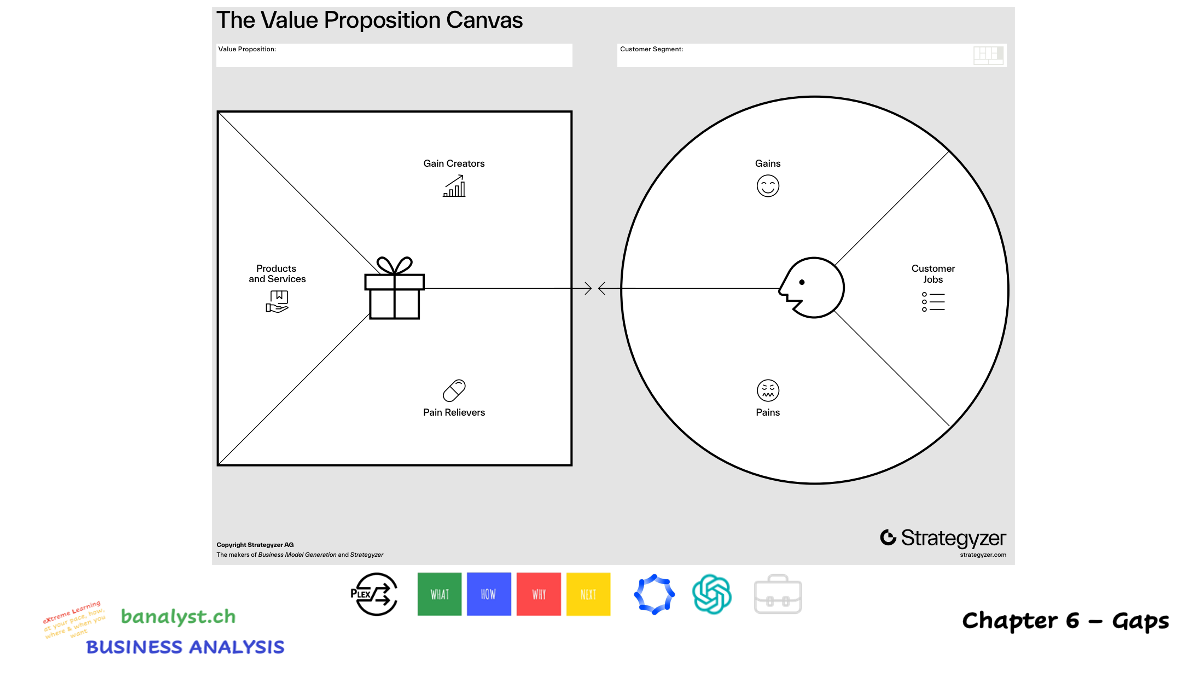
The Value Proposition Canvas is a strategic tool designed to help businesses understand and align their products or services with the needs, pains, and gains of their customers. It consists of two main parts: the customer profile, which outlines the customer segments, their jobs, pains, and gains; and the value map, which describes how the business's products or services create value by addressing those jobs, alleviating pains, and creating gains. This tool facilitates a deeper insight into customer needs and behaviors, ensuring that the value proposition is sharply focused on what is most relevant to the target market.
HOW
Creating a Value Proposition Canvas starts with understanding your customers deeply. First, identify the jobs your customers are trying to get done, their pains which are the obstacles and challenges they face, and the gains they seek which are the benefits or outcomes they desire. This helps in mapping the current solution's alignment with customer needs.
Next, articulate your product or service's features as pain relievers and gain creators, directly addressing the customer's jobs, pains, and gains. This step is crucial for innovating or improving your value proposition, ensuring that your solution not only meets current needs but also anticipates future desires or solves emerging problems.
Finally, the gaps between a current and a new solution become evident when comparing the customer profile with your value map. These gaps highlight opportunities for improvement or innovation, guiding the development of a new solution more closely aligned with evolving customer expectations. Addressing these gaps effectively can significantly enhance your value proposition, making your solution more attractive and competitive in the market.
WHY
A Value Proposition Canvas is created during Business Analysis to ensure that a product or service is designed around what the customer truly values. It bridges the gap between the product offering and customer expectations, identifying misalignments and uncovering opportunities for innovation. This strategic tool aids in refining a product's value proposition, making it more compelling and closely aligned with customer needs, thereby increasing its chances of success in the market.
NEXT
Here is a explanation of how a Force Field Analysis can influence the chapters of the business analysis report:
- Introduction (1.3 Methodology and approach) - Explaining how the Value Proposition Canvas was used to align the project's approach with customer needs.
- Customer Analysis (4.1-4.3) - Detailed insights into customer segments, needs, pain points, and behavior derived from the canvas.
- SWOT Analysis (5.3 Opportunities) - Opportunities identified through aligning products/services with customer jobs, pains, and gains.
- Solution Options (6.3 Recommendation and justification) - Recommendations for solutions informed by the value proposition's alignment with customer needs.
- Requirements (9.1 Functional requirements) - Functional requirements drawn from the value proposition to ensure the solution meets customer expectations.
- Conclusion (10.2 Implications and next steps) - Discussing the implications of the value proposition alignment on strategic decisions and next steps.
PROMPT
[instruction]
Based on the [case], the [pestel],[swot],[porters], [business context], [power-interest], [stakeholder-trend], [opportunities], [risks], [fishbone], [catwoe], [current story], [future story] the different [persona], the [force field analysis], [gaps] and [popit] above, create the [value proposition canvas]. List the key elements as bullet points for each part of the [value proposition canvas]. Put the parts between [ ]
CREDITS
Course : Business Analysis & Requirements Engineering
Institution : HES-SO Valais Wallis, 3960 Sierre
Teachers : Thomas Steiner & Catherine Tacchini
Credits
- FTO : X.XX ECTS
- FIG : X.XX ECTS
Objectives (with Babok 3 chapters)
- I have basic knowledge of maintaining requirement and design information. 5.2.4.1
- I have basic knowledge of managing attributes. 5.2.4.2
- I have basic knowledge of managing requirements for long term reuse. 5.2.4.3
- I understand allocating requirements to solution components and releases. 7.5.4.3
- I have basic knowledge of determining the value of a solution to key stakeholders. 7.6.4.3
- I have basic knowledge of assessing design options and recommending the appropriate solution. 7.6.4.4
- I have created a Value Proposition Canvas. case study
EXPLAINED
video explanations follow
PLEX
A PLEX, or Peer LEarning eXperience, is a self-contained, micro-learning unit created by students or teachers, designed to answer key questions like 'what?', 'how?', 'why?', and 'what's next?'. Each PLEX clearly outlines its learning objectives, associated micro-credits, and provides details about its original authors and their affiliations, making it a versatile resource for integration into various learning environments.
CUSTOMER JOBS
The "Customer Jobs" dimension in a Value Proposition Canvas represents the tasks or objectives that customers are trying to accomplish in their work or life. This could include functional jobs (specific tasks), social jobs (how they want to be perceived by others), personal/emotional jobs (how they want to feel), or supporting jobs (related to the purchasing or consumption process). Understanding customer jobs helps businesses tailor their value propositions to directly address what customers are trying to achieve, ensuring the product or service meets real needs and adds genuine value.
PAINS
The "Pains" dimension in a Value Proposition Canvas identifies the negative experiences, risks, obstacles, and challenges customers face when trying to accomplish their jobs. This aspect helps businesses understand what makes customers feel bad, what hurdles they encounter, or what might prevent them from achieving their objectives, allowing for the development of solutions that specifically target and alleviate these pains.
GAINS
The "Gains" dimension in a Value Proposition Canvas captures the benefits, outcomes, or achievements that customers hope to attain. This includes what customers aspire to gain, such as positive emotions, cost savings, or improvements in efficiency. Understanding gains allows businesses to highlight how their products or services can deliver added value, exceed customer expectations, and fulfill their desires or end goals, making the offering more attractive and compelling.
PAIN RELIEVERS
The "Pain Relievers" dimension in a Value Proposition Canvas specifically addresses how a product or service can alleviate the pains customers experience while trying to complete their jobs. This includes offering solutions to remove obstacles, reduce frustrations, or mitigate potential risks customers face. Pain relievers highlight the direct benefits of a product or service, showing how it solves specific customer problems, improves their experience, or removes barriers to achieving their goals.
GAIN CREATORS
The "Gain Creators" dimension in a Value Proposition Canvas details how a product or service enhances customer gains by offering new benefits or making existing jobs easier, more enjoyable, or more satisfying. It focuses on how the offering can exceed customer expectations, provide additional benefits, and create positive outcomes that customers may not have even anticipated, thereby creating a strong incentive for customers to choose the product or service.
PRODUCTS & SERVICES
The "Products and Services" dimension in a Value Proposition Canvas outlines the specific offerings a business provides to its customers. This part of the canvas focuses on the tangible products and intangible services designed to meet customer needs, relieve pains, and create gains. It's essential for demonstrating how the business's offerings align with and support the customer's jobs, making it easier for them to achieve their goals and improve their overall experience.
VALUE PROPOSITION
The "Value Proposition" in a Value Proposition Canvas articulates the unique value a product or service offers to the customer. It bridges the customer's needs, pains, and gains with the company's offerings, highlighting how the product or service uniquely addresses and resolves customer challenges while enhancing their desired outcomes. This concise statement is crucial for capturing the essence of what makes the offering attractive to target customers, distinguishing it from competitors in the market.
CUSTOMER SEGMENT
The "Customer Segment" title in a Value Proposition Canvas defines the specific group of customers targeted by the value proposition. It encompasses the characteristics, needs, pains, and gains of this group, ensuring the product or service is tailored to meet their specific requirements and preferences. This segmentation helps in focusing the value proposition on the needs of a well-defined customer group, making the offerings more relevant and attractive to them.
STRATEGYZER (copyright)
Strategyzer is a company specializing in tools and training for corporate innovation strategy. Co-founded by Alexander Osterwalder, it offers platforms and services designed to help businesses transform the way they view, measure, and deliver innovation. Strategyzer is known for its development and popularization of the Business Model Canvas and Value Proposition Canvas, which are strategic management tools used worldwide by startups, corporations, and consultants to design, test, build, and manage business models and value propositions. Their work emphasizes creating and managing new business models to ensure organizations can innovate and stay competitive. Strategyzer provides a variety of resources, including advising, coaching, training programs, and an innovation platform to support businesses in mastering the practice of innovation autonomously and at scale
Recommended reading : Osterwalder, A., Pigneur, Y., Bernarda, G., Smith, A. & T. Papadakos. Value Proposition Design: How to Create Products and Services Customers Want (Strategyzer). Wiley, 2014