Tool 5.1 - Stakeholder Stories
WHAT
Stakeholder stories are vital in business analysis for several reasons. These narratives, often referred to as user stories or customer stories in some methodologies, encapsulate the needs, experiences, and goals of stakeholders in a project or business initiative. They serve as a tool for understanding and prioritizing stakeholder requirements by presenting them in a relatable and concise format. Stakeholder stories help bridge the gap between technical teams and business stakeholders by providing a clear picture of what stakeholders expect from a solution or change. By focusing on specific examples of user needs or problems, these stories facilitate more effective and targeted solution development. Furthermore, stakeholder stories support iterative development processes by allowing for quick adjustments based on feedback, enhancing the agility and responsiveness of project teams to changing business environments.
HOW
Writing stakeholder stories, particularly when distinguishing between current and future states, involves a detailed understanding of stakeholders' present circumstances, needs, and the envisioned improvements or changes. Here’s how you can structure this process:
Understanding the Current State
Identify Stakeholders: Start by identifying who your stakeholders are. This includes anyone who has a stake in the outcome of the project or initiative, such as users, customers, employees, or external partners.
Gather Current Stories: Collect information about the current experiences, problems, and needs of these stakeholders. This can be achieved through interviews, surveys, observations, or reviewing existing documentation.
Write the Current Story: Craft a narrative that describes the current situation from the stakeholders' perspective. Focus on their experiences, challenges, and what they need from a solution. This story should be specific and detailed, highlighting the pain points and limitations of the current state.
Format: As a [role], I [experience this problem] because [reason].
Example: As a customer service representative, I spend a lot of time manually entering customer data into multiple systems because our current software doesn't integrate with other applications.
Envisioning the Future State
Define Desired Outcomes: Based on the current stories and the identified problems or needs, define what a successful outcome would look like for the stakeholders. What changes or improvements are needed?
Develop Future Stories: Write narratives that describe how stakeholders’ experiences and interactions will change for the better in the future state. These stories should focus on the benefits and improvements that come with the proposed solutions or changes.
Highlight the Differences: Clearly articulate how the future stories differ from the current stories. This contrast should showcase the value and impact of the proposed changes.
Format: In the future, as a [role], I will be able to [benefit or action] because [solution or change].
Example: In the future, as a customer service representative, I will be able to instantly access and update customer data across all systems through a single interface, because our new software will fully integrate with other applications.
Writing Tips
Keep it Simple and Clear: Use straightforward language that can be easily understood by everyone, avoiding jargon and technical terms.
Be Specific and Actionable: Provide enough detail in both the current and future stories to make the problems and solutions clear. Avoid vague descriptions.
Focus on the User: Center the narrative around the stakeholder’s experiences and needs, not the technology or processes.
Iterate and Validate: Share the stories with stakeholders for feedback and refine them as needed to ensure they accurately reflect stakeholders' needs and expectations.
By separating the current and future stakeholder stories, you create a compelling narrative for change, making it easier for project teams and stakeholders to align on the goals and vision of a project or initiative.
WHY
Stakeholder stories are a fundamental tool in business analysis for several compelling reasons, deeply rooted in the goals and methodologies of the discipline. These reasons reflect the core principles of business analysis, emphasizing the importance of understanding stakeholder needs, facilitating effective communication, and ensuring the delivery of value. Here's why stakeholder stories are written in business analysis:
1. Enhanced Stakeholder Engagement
Empathy and Understanding: Stories enable business analysts to present stakeholder needs and experiences in a relatable way, fostering empathy among project team members. This understanding is crucial for developing solutions that genuinely meet stakeholders' needs.
Active Participation: By framing requirements in the context of real-world scenarios, stakeholders are more likely to engage actively in discussions, feedback, and validation processes. This collaborative approach enriches the solution development process.
2. Improved Communication
Common Language: Stakeholder stories help bridge the communication gap between technical teams and non-technical stakeholders. By using narrative forms, complex requirements are translated into accessible, understandable scenarios.
Clarity and Focus: Stories distill complex information into the essence of what stakeholders need and why. This clarity prevents misinterpretations and keeps the project focused on delivering value.
3. Effective Prioritization
Identifying Core Needs: Stories highlight the most pressing problems and opportunities from the stakeholders' perspectives. This helps in prioritizing features, improvements, and tasks based on their potential impact on stakeholders' experiences.
Aligning Business Goals: By connecting stakeholder needs directly to business objectives, stories ensure that the project remains aligned with the overarching goals of the organization. This alignment is crucial for securing buy-in and resources from decision-makers.
4. Facilitating Solution Design
Solution Exploration: Stakeholder stories serve as a starting point for exploring potential solutions. They provide a clear context for brainstorming, prototyping, and testing different approaches to meet the defined needs.
Validation and Feedback: With stories outlining the desired future state, it becomes easier to validate proposed solutions against stakeholders' expectations and gather targeted feedback. This iterative process enhances the quality and relevance of the solution.
5. Supporting Agile Methodologies
Iterative Development: In agile frameworks, stakeholder stories are integral to the iterative development process. They allow for incremental improvements and refinements based on ongoing stakeholder feedback.
User-Centered Design: Agile methodologies emphasize user-centered design, and stakeholder stories put the needs and experiences of the end-users at the forefront of the development process.
Stakeholder stories embody the principles of empathy, clarity, and value-driven analysis that are central to business analysis. They not only facilitate effective communication and collaboration but also ensure that solutions are directly tied to stakeholder needs and business objectives. By leveraging these narratives, business analysts can navigate complex business environments, drive meaningful change, and deliver solutions that truly make a difference.
NEXT
Here is a explanation of how Stakeholder Stories can influence the chapters of the business analysis report:
1. Introduction
1.1 Background and context: Use stakeholder stories to illustrate how the current situation affects different stakeholders, setting the stage for why the report matters.
1.3 Methodology and approach: Mention how stakeholder stories were used as part of the data collection or analysis method to ensure user-centered analysis.
2. Problem Statement
2.1 Definition of the problem: Integrate stakeholder stories to put a human face on the abstract issues, making the problems more relatable and urgent.
2.2 Root cause analysis: Refer to specific stories that exemplify the root causes of the identified problems.
2.3 Impact and consequences: Use stories to highlight the real-world impacts of the problem on stakeholders, enhancing the urgency of finding a solution.
3. Market and Industry Analysis
3.1 Market overview and trends: While not the primary section for stakeholder stories, you might reference stories that exemplify how market trends directly affect stakeholders.
4. Customer Analysis
4.1 Customer segments and profiles: Use stories to describe the characteristics and needs of different customer segments vividly.
4.2 Customer needs and pain points: Stakeholder stories are crucial here to provide concrete examples of customer pain points and needs.
4.3 Customer behavior and preferences: Include stories that showcase typical or significant customer behaviors and preferences.
5. SWOT Analysis
Although not a typical section for detailed stories, brief references to stakeholder stories could be made, especially when discussing weaknesses (as they relate to customer pain points) and opportunities (in terms of addressing stakeholder needs).
6. Solution Options
6.1 Alternative solutions: Use stakeholder stories to illustrate how each solution could meet the needs or solve the problems identified in the stories.
6.3 Recommendation and justification: Support the recommended solution with stories that demonstrate its potential to effectively address key stakeholder needs.
7. Business Case Development
7.3 Risk assessment and management: Reference stakeholder stories when discussing potential risks, especially those that could impact user satisfaction or adoption.
8. Implementation Plan
This section might not directly include stakeholder stories, but references to the needs and expectations outlined through stories in earlier sections can guide the implementation priorities.
9. Requirements
9.1 Functional requirements: Directly tie stakeholder stories to specific functional requirements, showing how each requirement addresses a need or problem highlighted in a story.
9.2 Priorities: Use the urgency and impact illustrated in stakeholder stories to justify the prioritization of certain requirements over others.
10. Conclusion
10.1 Summary of findings and recommendations: Recap how stakeholder stories have shaped the analysis and recommendations, reinforcing the report’s user-centered approach.
10.2 Implications and next steps: Discuss how the insights from stakeholder stories will influence future actions and decision-making processes.
Integrating stakeholder stories throughout a Business Analysis report not only humanizes the data but also strengthens the argument for proposed changes or solutions by grounding them in real-world experiences and needs.
PROMPT
[instruction]
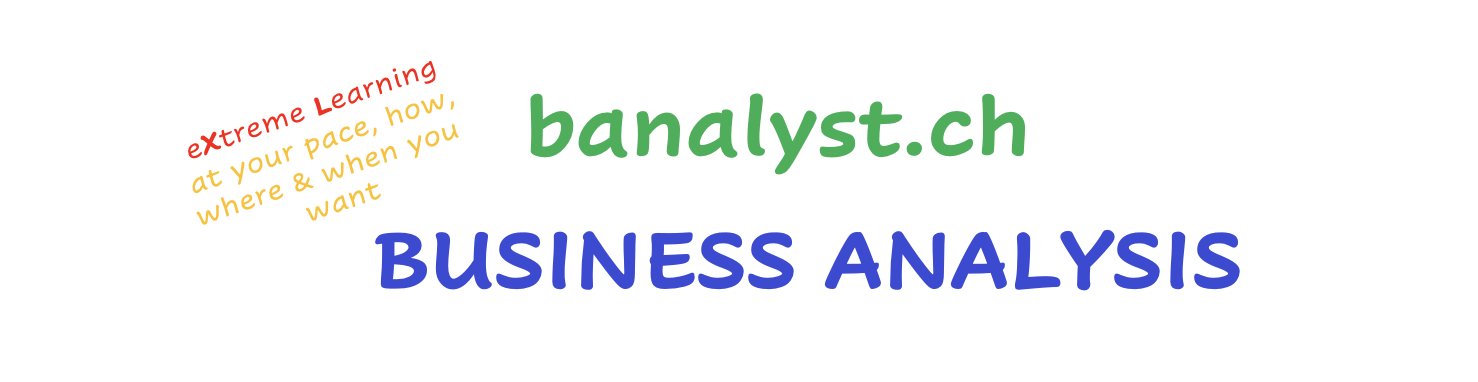
Based on the [case], the [pestel],[swot],[porters], [business context], [power-interest], [stakeholder-trend], [opportunities], [risks], [fishbone], [catwoe] analyses done above, write two stories for the main stakeholder. The first story describes how the main stakeholder interacts with the touch points in the current, problematic situation of the [case]. Write pain points in bold and red. The second story describes how the main stakeholder interacts with the touch points in the resolved [case]. Write reliever points in bold and green. Structure the results as [current story] and [future story] and place the respective texts indented under these sections.
CREDITS
Course : Business Analysis & Requirements Engineering
Institution : HES-SO Valais Wallis, 3960 Sierre
Teachers : Thomas Steiner & Catherine Tacchini
Credits
- FTO : X.XX ECTS
- FIG : X.XX ECTS
Objectives (with Babok 3 chapters)
- I understand requirements classification schema. 2.3
- I understand requirements and designs. 2.5
- I understand considering value and relationships while tracing requirements. 5.1.4.1
- I understand identifying the relationships to track to effectively manage traceability. 5.1.4.2
- I follow rules to determine appropriate traceability repository. 5.1.4.3
- I have basic knowledge of defining measurable evaluation criteria to assess the success of change. 7.3.4.2
- I understand identifying appropriate solution approaches. 7.5.4.1
- I understand identifying improvement opportunities. 7.5.4.2
- I understand developing design options aligned with the desired future state. 7.5.4.4
- I have applied stakeholder stories. case study
EXPLAINED
video explanations follow
PLEX
A PLEX, or Peer LEarning eXperience, is a self-contained, micro-learning unit created by students or teachers, designed to answer key questions like 'what?', 'how?', 'why?', and 'what's next?'. Each PLEX clearly outlines its learning objectives, associated micro-credits, and provides details about its original authors and their affiliations, making it a versatile resource for integration into various learning environments.
CURRENT STORY
The role of the current stakeholder story in business analysis involves understanding and documenting the needs, expectations, and experiences of stakeholders with the current state or system. It serves as a tool to capture the real-world context in which stakeholders operate, their challenges, and what they value. This narrative can highlight gaps, inefficiencies, and opportunities for improvement, guiding the development of solutions that are closely aligned with stakeholder requirements and contribute to more effective and user-centric outcomes.
FUTURE STORY
The future stakeholder story outlines stakeholders' expectations, needs, and experiences within a proposed future state or system. It serves as a vision for how solutions will address current issues, fulfill requirements, and improve stakeholder satisfaction. This narrative helps guide the development process, ensuring solutions are designed with a clear understanding of desired outcomes, facilitating better alignment with stakeholder goals, and promoting engagement by illustrating the benefits and changes stakeholders can anticipate.
PAINS
The current stakeholder story contains "pain" points.
RELIEVERS
The future stakeholder story contains "relievers" which reduce or completely remediate to the "pains" of the current stakeholder story.
Tool 5.2 - Persona
WHAT
Personas are a fundamental tool in business analysis, designed to represent the characteristics of a group of users, customers, or stakeholders that might use a service, product, brand, or system. They are fictional characters created based on research to represent the different user types that might use a service or product in a similar way. Developing personas helps businesses understand their customers' needs, experiences, behaviors, and goals, which is crucial for creating a user-centered design. Personas provide insights into what users might want to achieve, their expectations, how they're likely to interact with a product or service, and the challenges they face. This focus enables businesses to design solutions that meet users' needs effectively, enhancing user satisfaction and engagement. Personas are a key component in the business analysis process, offering a clear, shared understanding of the user for everyone involved in the creation and delivery of a product or service.
HOW
Creating personas is a structured approach that involves research, analysis, and synthesis of data about potential users. Here's a step-by-step guide to creating effective personas for business analysis or user experience design:
Research Your Users: Begin with collecting data about your potential or existing users. Use a mix of quantitative methods (such as surveys and analytics) and qualitative methods (like interviews and observation) to gather a comprehensive understanding of your user base. Focus on demographics, behavior patterns, goals, needs, challenges, and preferences.
Segment Your Data: Look for patterns and commonalities in the data you've collected. Group users by similar behaviors, goals, and needs. This segmentation helps identify distinct user types within your broader user base.
Draft Persona Profiles: For each user group identified, create a draft persona. A persona typically includes:
- Name and Photo: Give your persona a name and a photo to make it more relatable.
- Demographics: Include age, education, occupation, and any other relevant demographic information.
- Background: Provide a brief backstory to add depth, including professional background, tech-savviness, and any other relevant context.
- Goals and Needs: What are the primary and secondary goals your persona seeks to achieve using your product or service?
- Pain Points: What challenges or obstacles do they face in achieving these goals? In our methodology, the pains can taken from the current stakeholder story (red parts).
- Behaviors: How does your persona typically behave in the context of your product or service? Include how they make decisions.
- Preferences: What preferences do they have regarding your product or service?
- In our methodology we add the relievers directly to the persona. The relievers can be taken from the future stakeholder story (green parts).
Refine Your Personas: Review the draft personas with stakeholders, including team members from design, development, marketing, sales, and customer service. Use their feedback to refine each persona. Ensure each persona is distinct and represents a significant portion of your user base.
Create Scenarios for Each Persona: Develop scenarios in which each persona interacts with your product or service. Scenarios should reflect real-world use cases and challenges to help envision how your personas would use and react to your product or service.
Validate and Update Personas: Personas should not be static. Validate them by continually collecting user data and feedback. Update your personas as your product evolves and as you gain deeper insights into your users.
Use Personas Throughout the Product Development Process: Integrate personas into the product development lifecycle. Use them to guide design decisions, prioritize features, and tailor marketing strategies. Personas should be a reference point for understanding user needs and expectations.
Creating personas is a dynamic process that requires ongoing attention and adaptation. By maintaining accurate and detailed personas, businesses can ensure that their products and services remain user-centered, addressing real user needs and improving user experience.
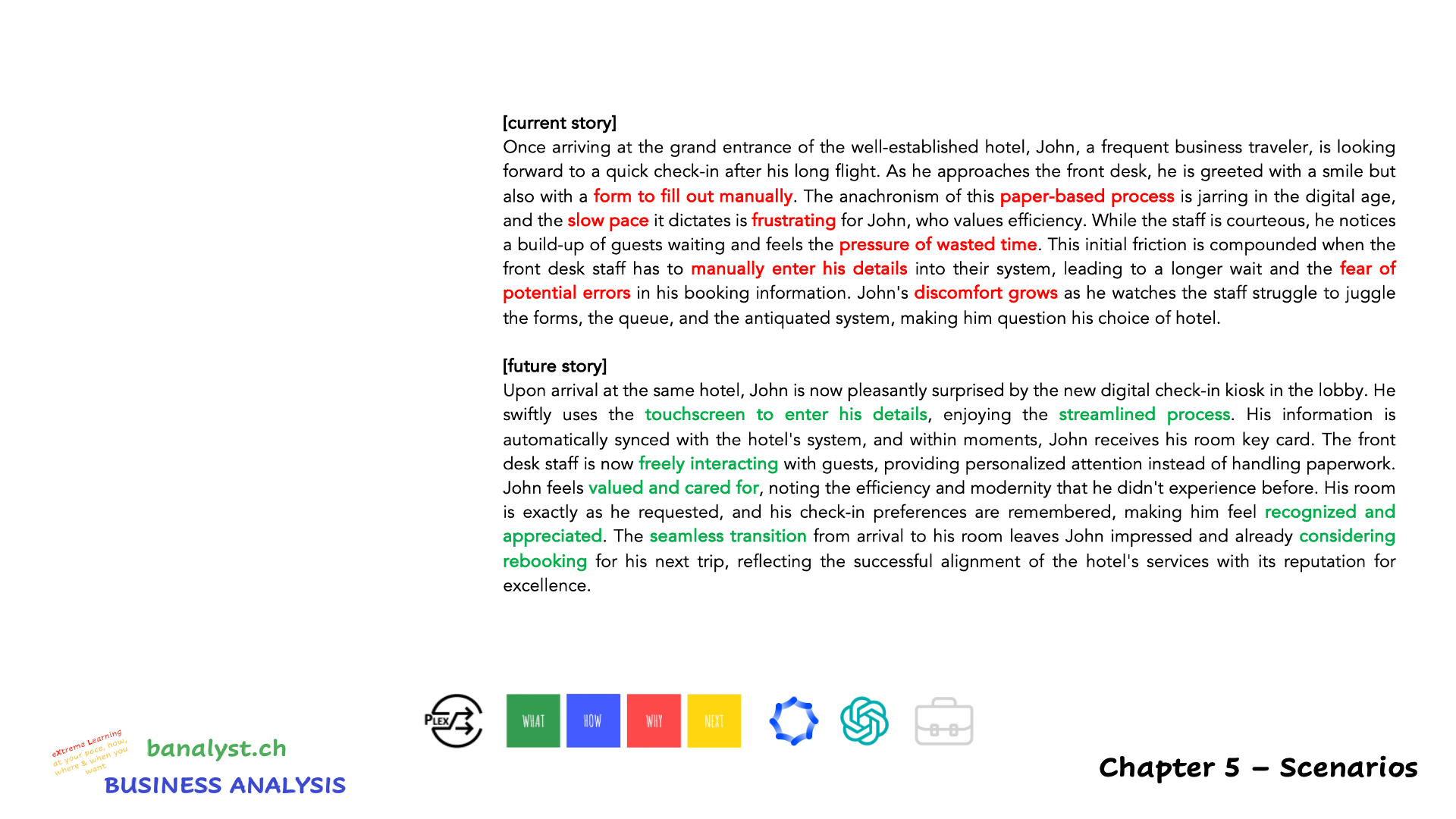
There are many ways to represent persona. In our methodology we choose a simplified approach representing at least the jobs / needs, the pains and the relievers.
WHY
Personas are created in Business Analysis for several pivotal reasons, each contributing to the development of solutions that are more closely aligned with the needs, preferences, and behaviors of the end-users. Here’s why personas are such a crucial tool in Business Analysis:
- Enhanced User Understanding: Personas provide a vivid, detailed understanding of the users, going beyond basic demographics to include goals, challenges, behaviors, and preferences. This rich understanding helps the business analysis and development teams to empathize with the users, seeing the product or service from their perspective.
- Improved Focus: By creating detailed personas, teams can keep a consistent focus on the user throughout the project lifecycle. This user-centered focus ensures that design and development efforts are directed towards solutions that meet real user needs, rather than being based on assumptions or internal biases.
- Facilitates Clear Communication: Personas serve as a common language for stakeholders across different functions of an organization, including marketing, product development, design, and customer service. They help ensure that everyone has a clear and consistent understanding of who the users are, their needs, and how the project aims to serve them.
- Guides Decision Making: With a clear understanding of the target users represented by personas, business analysts and project teams can make informed decisions about feature prioritization, design choices, and the overall direction of the project. This leads to a more strategic allocation of resources and efforts towards what matters most to the users.
- Enhances User Experience: By grounding the project in the realities of user needs and behaviors, personas help in creating products, services, or solutions that offer a better user experience. This user-centric approach can lead to higher satisfaction, increased usage, and loyalty, ultimately contributing to the success of the solution.
- Identifies Gaps and Opportunities: The process of creating personas can reveal gaps in current offerings or uncover new opportunities for innovation. Understanding the varied needs and pain points of different user groups can lead to the discovery of unmet needs or potential areas for differentiation.
- Supports User-Centered Design: Personas are integral to user-centered design processes, helping teams to design with empathy. They ensure that usability, accessibility, and the overall user journey are considered from the earliest stages of design and development, leading to solutions that are better suited to the users they aim to serve.
- Facilitates Testing and Validation: Personas can be used to guide usability testing and validation activities. By testing with users who closely resemble the created personas or by using personas to evaluate design concepts, teams can gain insights into how well their solutions meet actual user needs.
NEXT
Here is a explanation of how Persona can influence the chapters of the business analysis report:
Personas, as detailed representations of user segments, are invaluable throughout various sections of a Business Analysis report, helping to align the analysis, recommendations, and strategies with the needs, behaviors, and preferences of the target users. Here’s how personas could be integrated into each relevant chapter of the report:
1. Introduction
1.1 Background and context: Include personas to provide context on the user segments that the project aims to serve.
1.3 Methodology and approach: Describe how personas were developed and utilized in the research and analysis process.
2. Problem Statement
While personas are not directly included here, understanding them can shape the definition of the problem, root cause analysis, and the perceived impact from the users' perspective.
3. Market and Industry Analysis
This section typically focuses on broader market and industry trends rather than individual user behaviors. However, insights gained from developing personas can inform the analysis, especially regarding customer behavior trends and market needs.
4. Customer Analysis
4.1 Customer segments and profiles: Directly include or reference personas to describe distinct customer segments.
4.2 Customer needs and pain points: Use personas to detail specific needs and pain points for each user segment.
4.3 Customer behavior and preferences: Personas can provide detailed insights into the behaviors and preferences of different user groups, grounding this section in concrete user data.
5. SWOT Analysis
Personas inform the SWOT analysis by highlighting strengths and opportunities related to user experience and potential weaknesses or threats from user pain points or unmet needs.
6. Solution Options
6.3 Recommendation and justification: Use personas to justify recommended solutions based on how well they meet the needs and solve the problems of each persona.
7. Business Case Development
Personas can inform parts of the business case, especially when assessing the benefits of a solution in meeting user needs and preferences, which could be reflected in cost-benefit analysis and risk assessment.
8. Implementation Plan
While more focused on project management, understanding personas can help ensure that the plan considers the user impact and user adoption strategies.
9. Requirements
9.1 Functional requirements: Directly reference personas when specifying requirements to ensure they are rooted in real user needs.
9.2 Priorities: Prioritize requirements based on their importance to the personas, ensuring the most critical user needs are addressed first.
10. Conclusion
10.1 Summary of findings and recommendations: Reiterate how the findings and recommendations address the needs and preferences identified in the personas.
10.2 Implications and next steps: Discuss the implications of the recommendations on the personas and outline next steps based on persona-driven priorities.
PROMPT
[instruction]
Based on the [case], the [pestel],[swot],[porters], [business context], [power-interest], [stakeholder-trend], [opportunities], [risks], [fishbone], [catwoe], [current story], [future story] above, generate 5 different persona for the main stakeholder. Vary on age, gender, <add your other variables here>, pains from the [current story], relievers from [future story], the satisfaction level with the [current story]. Put the name of the persona between [ ] and indent there descriptions under these sections.
CREDITS
Course : Business Analysis & Requirements Engineering
Institution : HES-SO Valais Wallis, 3960 Sierre
Teachers : Thomas Steiner & Catherine Tacchini
Credits
- FTO : X.XX ECTS
- FIG : X.XX ECTS
Objectives (with Babok 3 chapters)
- I understand requirements classification schema. 2.3
- I understand requirements and designs. 2.5
- I understand considering value and relationships while tracing requirements. 5.1.4.1
- I understand identifying the relationships to track to effectively manage traceability. 5.1.4.2
- I follow rules to determine appropriate traceability repository. 5.1.4.3
- I have basic knowledge of defining measurable evaluation criteria to assess the success of change. 7.3.4.2
- I understand identifying appropriate solution approaches. 7.5.4.1
- I understand identifying improvement opportunities. 7.5.4.2
- I understand developing design options aligned with the desired future state. 7.5.4.4
- I have applied persona. case study
EXPLAINED
video explanations follow
PLEX
A PLEX, or Peer LEarning eXperience, is a self-contained, micro-learning unit created by students or teachers, designed to answer key questions like 'what?', 'how?', 'why?', and 'what's next?'. Each PLEX clearly outlines its learning objectives, associated micro-credits, and provides details about its original authors and their affiliations, making it a versatile resource for integration into various learning environments.
VARIABLES
Variables play a crucial role in generating personas by defining and segmenting different characteristics of target users. These variables can include demographic information, behavior patterns, goals, motivations, and pain points. By analyzing these variables, you can create detailed personas that represent segments of your user base, allowing for more tailored and effective product development, marketing strategies, and customer experiences.
JOBS
In persona generation, "jobs" or "needs" refer to the tasks the persona aims to accomplish or the requirements they seek to fulfill through the use of a product or service. This concept helps in understanding what drives the behavior of different user segments, guiding the design, development, and marketing of solutions that are deeply aligned with user expectations and goals, ultimately enhancing user satisfaction and engagement.
PAINS
In persona creation, "pains" describe the challenges, frustrations, and obstacles that a persona faces in achieving their goals or fulfilling their needs. Recognizing these pains is crucial for developing solutions that address and alleviate these issues, leading to products or services that are more effectively aligned with user expectations and requirements. Understanding pains helps in prioritizing features and designing user experiences that significantly improve customer satisfaction and loyalty. In our methodology, pains can be derived from the current stakeholder story (red parts).
RELIEVERS
In persona generation, "relievers" are solutions or features that alleviate the pains experienced by the persona. They represent how a product or service can solve problems, reduce frustrations, or eliminate obstacles that personas face in their journey. Identifying relievers is essential for designing offerings that not only meet the needs and wants of the target audience but also provide a compelling reason for them to choose your solution over others, enhancing user satisfaction and fostering loyalty. In our methodology, relievers can be derived from the future stakeholder story.
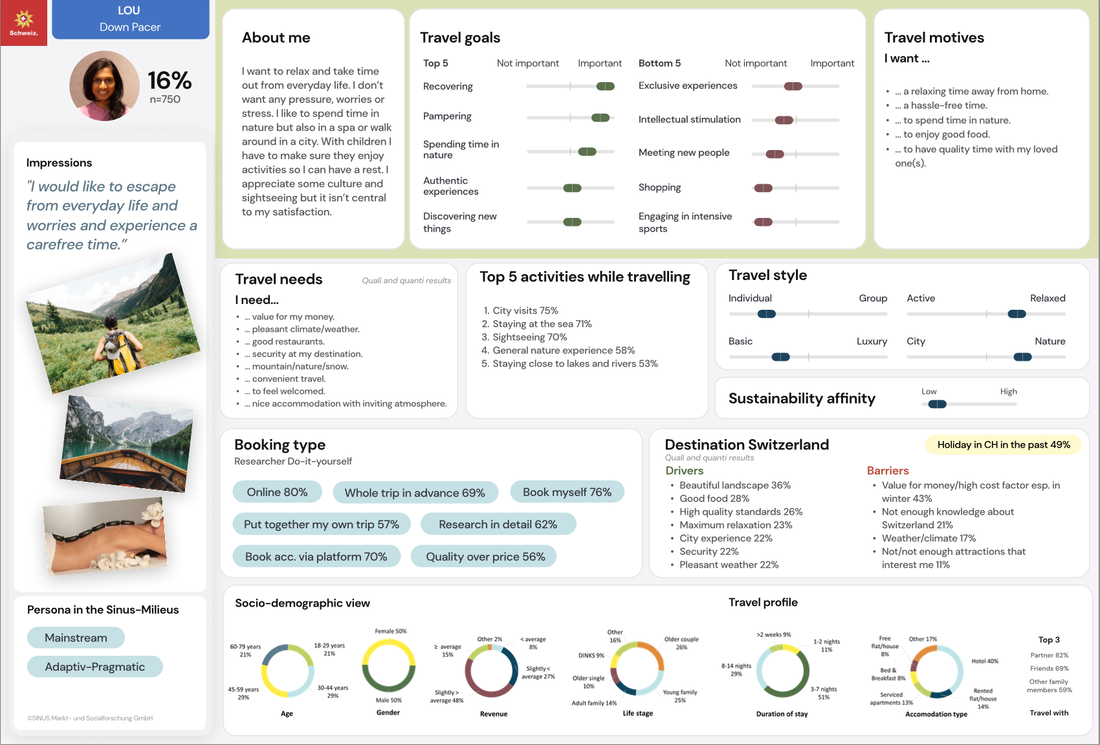
Another Persona Example
Tool 5.3 - Force Field Analysis
WHAT
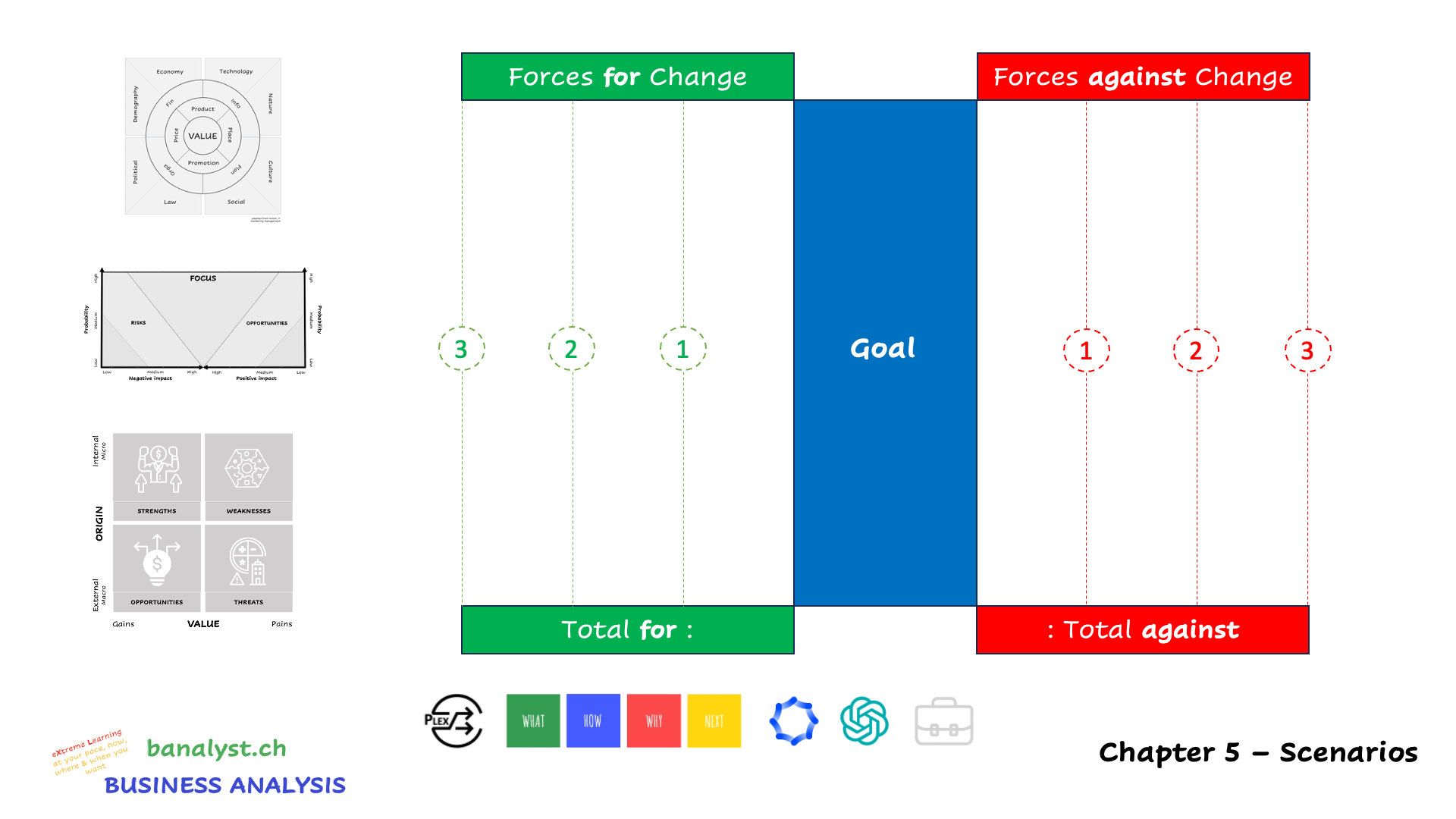
Force Field Analysis is a powerful decision-making tool widely used in business analysis to assess the forces that either drive or restrain change within an organization. It helps in understanding what factors are working in favor of a change (driving forces) and which are against it (restraining forces). By identifying these forces, organizations can develop strategies to reinforce driving forces and reduce or eliminate restraining forces, thereby facilitating effective change management. This technique is beneficial in strategic planning, enabling stakeholders to visualize and address potential obstacles in the implementation of new initiatives or changes. Through its systematic approach, Force Field Analysis assists in enhancing decision-making processes, ensuring a more comprehensive understanding of the dynamics at play within the organization's environment.
HOW
To conduct a Force Field Analysis, you follow a structured process that helps identify and evaluate the forces for and against a change. Here’s a step-by-step guide:
1. Define the Change Objective
Clearly state the change you want to achieve. This could be a specific goal, problem solution, or improvement you wish to implement within your organization.
2. Set Up the Force Field Diagram
Draw a line down the center of a piece of paper or a digital document. Write the change objective at the top. Label one side of the line "Driving Forces" and the other side "Restraining Forces".
3. Identify Driving Forces
List the factors that are driving or supporting the change on the left side of the diagram. These could include internal and external pressures for change, resources that support the change, stakeholders in favor of the change, and any other positive influences.
4. Identify Restraining Forces
On the right side of the diagram, list the factors that are resisting or obstructing the change. These could include resistance from employees, limited resources, regulatory constraints, organizational culture, or any other barriers.
5. Analyze and Prioritize Forces
Evaluate each force based on its strength and impact on the change process. You may assign a numerical score to each force to quantify its strength or simply discuss and agree on which forces are the most potent.
6. Develop Strategies
For each of the significant forces identified, develop strategies that will either strengthen the driving forces or weaken the restraining forces. The aim is to alter the balance so that the driving forces outweigh the restraining forces.
7. Action Planning
Based on the strategies developed, create a detailed action plan to address the key forces. Assign responsibilities, resources, and timelines for each action.
8. Implement and Monitor
Begin implementing the action plans, continuously monitoring the impact on the driving and restraining forces. Be prepared to adapt your strategies in response to changes in the force field.
9. Review and Revise
Regularly review the progress towards achieving the change objective. If necessary, revisit the force field analysis to identify any new forces or changes in the strength of existing forces, adjusting your strategies accordingly.
Force Field Analysis is an iterative process. As changes are implemented, the forces at play may evolve, requiring ongoing assessment and adaptation of strategies. This method not only helps in planning and implementing change but also in anticipating challenges and engaging stakeholders in the change process.
WHY
Force Field Analysis is utilized in Business Analysis for several critical reasons, offering a structured methodology for navigating the complexities of change within organizations. Here's why it is particularly valuable:
1. Understanding the Change Dynamics
Force Field Analysis helps business analysts and stakeholders understand the full spectrum of forces acting upon a potential change. By identifying driving forces that promote change and restraining forces that hinder it, the analysis provides a comprehensive view of what the organization is up against, facilitating more informed decision-making.
2. Facilitating Stakeholder Engagement
This analysis technique encourages the involvement of various stakeholders, promoting a collaborative approach to change. Engaging diverse stakeholders in identifying forces ensures a broad perspective is considered, increases buy-in, and helps in identifying potential resistance early in the change process.
3. Strategic Planning and Decision Making
The insights gained from a Force Field Analysis can be crucial in strategic planning. They allow business analysts to prioritize efforts and resources effectively, focusing on strengthening driving forces or mitigating restraining forces to make the change initiative more successful.
4. Risk Management
By identifying restraining forces or barriers to change, Force Field Analysis serves as a proactive risk management tool. It allows organizations to anticipate potential challenges and develop strategies to address them before they become problematic, thus minimizing risks associated with the change.
5. Enhancing Implementation Success
Understanding both the positive and negative forces affecting a change initiative enables more effective planning and implementation. By developing targeted strategies to bolster driving forces and reduce restraining forces, organizations can enhance the likelihood of successful change implementation.
6. Continuous Improvement
Force Field Analysis is not a one-time activity; it can be revisited throughout the change process to reflect changing dynamics. This iterative approach supports continuous improvement, allowing organizations to adapt their strategies in response to new information or evolving conditions.
7. Organizational Learning and Adaptability
This analytical process fosters a learning culture within organizations, encouraging reflection on the success and challenges of change initiatives. Lessons learned can inform future projects, enhancing organizational adaptability and resilience.
NEXT
Here is a explanation of how a Force Field Analysis can influence the chapters of the business analysis report:
1. Introduction
1.3 Methodology and Approach: Include a brief explanation that Force Field Analysis was used as part of the methodology to understand the forces affecting the project or change initiative.
2. Problem Statement
2.1 Definition of the Problem: Use insights from the Force Field Analysis to clarify the problem by showing how certain forces are contributing to its existence.
2.2 Root Cause Analysis: Present how restraining forces identified in the analysis contribute to the root causes of the problem.
2.3 Impact and Consequences: Discuss how driving and restraining forces impact the organization and what the consequences are if no action is taken.
3. Market and Industry Analysis
While not directly applicable, understanding of external driving and restraining forces can inform the market and industry analysis.
4. Customer Analysis
4.2 Customer Needs and Pain Points: The analysis might reveal external forces related to customer needs and pain points that the proposed change aims to address.
5. SWOT Analysis
5.1 Strengths, 5.2 Weaknesses, 5.3 Opportunities, 5.4 Threats: The driving forces can be related to strengths and opportunities, while restraining forces might align with weaknesses and threats.
6. Solution Options
6.3 Recommendation and Justification: Use the Force Field Analysis to justify the recommended solution by showing how it addresses the driving forces and mitigates restraining forces.
7. Business Case Development
7.3 Risk Assessment and Management: The restraining forces identified can inform the risk assessment section, providing insights into potential risks and how they can be managed.
8. Implementation Plan
8.3 Responsibilities: The plan to enhance driving forces and reduce restraining forces can be detailed here, specifying responsibilities for managing these forces.
9. Requirements
This section may not directly incorporate Force Field Analysis results, but understanding the forces can help in defining more comprehensive and relevant functional requirements.
10. Conclusion
10.1 Summary of Findings and Recommendations: Summarize how the Force Field Analysis informed the report’s findings and shaped the recommendations.
10.2 Implications and Next Steps: Discuss the implications of driving and restraining forces on the project or initiative and outline next steps to address these forces effectively.
PROMPT
[instruction]
Based on the [case], the [pestel],[swot],[porters], [business context], [power-interest], [stakeholder-trend], [opportunities], [risks], [fishbone], [catwoe], [current story], [future story] and different [persona] above, generate a force field analysis. Identify the major 5 goals when tranforming the [current story] into the [future story]. Then identify for each goal the major positive and the major negative driving force. Give these positive and negative forces a value between 1 (weak) and 3 (strong). List the results with each goal between [ ] and indent the [positive force] with its name and its value and then the [negative force] with its name and its value. Sum up the values of the negative forces and sum up the values of the positive forces. Calculate the positive sum minus the negative sum.
After this formal list, summarize all this in a visually more attractive and readable table.
CREDITS
Course : Business Analysis & Requirements Engineering
Institution : HES-SO Valais Wallis, 3960 Sierre
Teachers : Thomas Steiner & Catherine Tacchini
Credits
- FTO : X.XX ECTS
- FIG : X.XX ECTS
Objectives (with Babok 3 chapters)
- I understand requirements classification schema. 2.3
- I understand requirements and designs. 2.5
- I understand considering value and relationships while tracing requirements. 5.1.4.1
- I understand identifying the relationships to track to effectively manage traceability. 5.1.4.2
- I follow rules to determine appropriate traceability repository. 5.1.4.3
- I have basic knowledge of defining measurable evaluation criteria to assess the success of change. 7.3.4.2
- I understand identifying appropriate solution approaches. 7.5.4.1
- I understand identifying improvement opportunities. 7.5.4.2
- I understand developing design options aligned with the desired future state. 7.5.4.4
- I have applied a force field analysis. case study
EXPLAINED
video explanations follow
PLEX
A PLEX, or Peer LEarning eXperience, is a self-contained, micro-learning unit created by students or teachers, designed to answer key questions like 'what?', 'how?', 'why?', and 'what's next?'. Each PLEX clearly outlines its learning objectives, associated micro-credits, and provides details about its original authors and their affiliations, making it a versatile resource for integration into various learning environments.
POSITIVE FORCES
In a Force Field Analysis, positive forces, or driving forces, are those factors that actively support or push toward the achievement of a change or goal, acting as enablers for progression and improvement. These forces can include internal motivations, external pressures, supportive stakeholders, and resources that facilitate the desired change, helping to overcome resistance and barriers represented by restraining forces. Identifying and strengthening these positive forces are critical strategies in change management, as they accelerate the momentum toward successful change implementation by creating a more favorable environment for the change to occur.
NEGATIVE FORCES
In Force Field Analysis, negative forces, or restraining forces, are factors that resist or oppose the desired change, acting as barriers that slow down or prevent progress toward achieving a goal or implementing a change. These forces can stem from a variety of sources such as organizational inertia, cultural resistance, resource limitations, or external constraints, creating challenges that need to be addressed for change to occur. The identification and understanding of these restraining forces allow organizations to develop targeted strategies to mitigate, reduce, or eliminate these barriers, facilitating a smoother transition and enhancing the likelihood of successful change implementation.
MACROSCOPE
The results of a global macroscope analysis provide a comprehensive view of the internal and external factors influencing a business, including marketing, management, and the broader socio-economic context. This holistic understanding identifies key areas of strength and potential resistance, which are crucial when determining the positive and negative forces in a force field analysis. By aligning the value proposition and strategic elements identified in the macroscope analysis with the goals in the force field analysis, organizations can more effectively predict, balance, and navigate the forces that will impact the transition from the current to the desired state.
OPPORTUNITIES-RISK MAP
An opportunities-risks map with an arrow of attention highlights the potential benefits and drawbacks of a strategic decision, prioritizing them based on their impact and likelihood. This map guides the focus towards critical areas that can either propel or hinder progress, providing a clear direction for action. Integrating this focused insight into a force field analysis helps in quantifying the driving and restraining forces, ensuring that the strategic goals are supported by maximizing opportunities and minimizing risks.
SWOT
A SWOT analysis identifies a business's internal strengths and weaknesses, as well as external opportunities and threats, which are pivotal in understanding the factors that can support or oppose a change initiative. The strengths and opportunities from the SWOT analysis can be translated into positive forces in the force field analysis, as they are elements that can drive the desired change forward. Conversely, the weaknesses and threats are considered negative forces in the force field analysis, representing obstacles or resistance that the change process must overcome or mitigate.